Tag: Federal Government of Nigeria
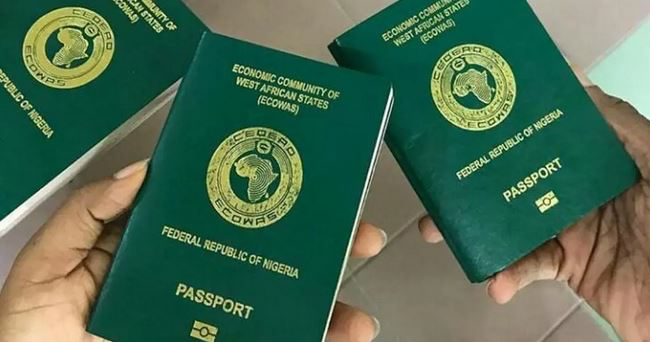
The Federal Government on Thursday justified the recent increase in Nigerian passport fees to ₦100,000 and ₦200,000, stating that the adjustment is aimed at sustaining service quality, curbing corruption, and ensuring timely issuance of travel documents.
The Nigeria Immigration Service, in a statement signed by its Public Relations Officer, ACI AS Akinlabi, on Thursday, announced that from September 1, 2025, applications made within Nigeria will attract new fees of N100,000 for the 32-page, five-year validity passport and N200,000 for the 64-page, 10-year validity passport.
“The review which only affect Passport Application fees made in Nigeria, now set a new fee thresholds for 32-page with five-year validity at N100,000 and 64-page with 10-year validity at N200,000,” the statement read.
The NIS, however, said Nigerians in the diaspora will continue to pay $150 for the 32-page, five-year passport and $230 for the 64-page, 10-year passport.
It explained that the adjustment was aimed at maintaining the integrity of the document while making issuance processes more efficient.
The increase comes barely a year after the Federal Government approved an earlier adjustment in August 2024, which raised the 32-page, five-year booklet from N35,000 to N50,000, and the 64-page, 10-year booklet from N70,000 to N100,000.
At the time, the NIS said the hike was necessary to sustain the quality of the passport and improve service delivery.
On Thursday, the Minister of Interior, Dr. Olubunmi Tunji-Ojo, defended the new hike.
Speaking in Abuja during the ministry’s mid-tenure performance retreat, Tunji-Ojo said the hike would ensure timely delivery of passport and eliminate corruption,
He said, “Our target is very clear: within one week of enrolment, every Nigerian should have their passport in hand. Not just delivering quickly, but delivering quality passports that reflect our integrity as a nation,” he said.
He noted that the new system was designed to eliminate long delays and extortion that once forced citizens to wait up to seven months or pay as much as N200,000 to fast-track processing.
“The system that we inherited that had six months backlog which we were able to clear in two and a half weeks. Nigerians will apply for passports and wait endlessly, or be asked to pay hundreds of thousands of naira.
“My own daughter had that bad experience. Even when I was chairman of the House Committee on NDDC, my daughter wanted passport, it was a problem. I had to pay hundreds of thousands to be able to get a passport for my daughter, a 12-year-old girl. That era is over,” Tunji-Ojo said.
The minister disclosed that the centralised personalisation centre, the largest in Africa, would ensure faster processing and tighter security.
“With this facility, we can print five times more passports than we currently need. Once you enrol, it doesn’t take us more than 24 hours to vet. Printing capacity is no longer our problem,” he explained.
As part of the reforms, Tunji-Ojo announced that Passport Control Officers will no longer have the power to approve or delay applications.
“Some PCOs had so much power that they could decide not to approve or not to print a passport until they were settled. That abuse of power ends now,” he declared.
According to him, centralising the approval process would curb corruption and restore credibility to Nigeria’s travel documents.
“We realised that the best way to cut corruption is to remove human contact to the barest minimum. Passport approval will no longer rest with PCOs. My responsibility is not for them to like me — it is to deliver efficiency. Let Nigerians be happy,” he said.
He added that the reforms will also protect the integrity of Nigeria’s passport.
“My responsibility is not just to make passports available, but to ensure that anybody carrying it is a Nigerian. If you are not a Nigerian, you cannot carry it. It’s about our national integrity.”
Citing past abuses, he recalled how foreigners once procured Nigerian passports illegally.
“In one incident, a Ugandan woman carrying a Nigerian passport was arrested at Lagos Airport after paying $1,000 to procure it. That cannot continue. Our passport must remain a true symbol of Nigerian identity,” the minister stressed.
After wrapping up its nationwide protests on Tuesday, the Academic Staff Union of Universities (ASUU) is preparing to hold congresses to determine its next steps.
Earlier in the year, the Tinubu administration released ₦50 billion to clear earned academic allowances owed to lecturers and university staff.
Today’s meeting is expected to include the Minister of Education, Dr. Tunji Alausa; the Minister of Labour and Employment, Muhammadu Maigari Dingyadi; and officials from the National Salaries, Incomes and Wages Commission. The session aims to produce a timetable for signing and gradually implementing the renegotiated agreement alongside related reports.
According to government insiders in the Education and Labour ministries, discussions will center on harmonizing the Yayale Ahmed committee draft completed in December 2024 with the original 2009 agreement and subsequent recommendations, such as the Nimi Briggs report. Another key focus will be determining how to spread the financial obligations across the national budget while creating a legally binding framework.
Speaking on Wednesday, ASUU president, Prof. Chris Piwuna, stressed that the union expects genuine commitment from the government.
He said …
“I truly hope they will come up with something tangible. Our members are tired of words and no action.”
Piwuna, however, made it clear that ASUU was not invited to participate in today’s meeting.
He emphasized that the union had concluded its nationwide protests and was now set to convene congresses to determine its next course of action.
“We don’t have any meeting with the Federal Government tomorrow (today). It’s their meeting, we’re not involved. We have not received any invitation yet for a meeting with the Federal Government.
“However, we’ll let Nigerians know our next line of action after the protests. We operate from the bottom up. The protests are over, so we’ll go back to our members and ask them what is next, and we’ll do exactly what they want us to do as elected representatives,” he added.
Today’s meeting is taking place against the backdrop of persistent complaints by ASUU members over poor remuneration and the declining state of academia. Reports indicate that professors, who earn around ₦500,000 monthly, are forced to reside in officers’ quarters and sometimes struggle to board buses meant for students.
According to documents obtained by The PUNCH, the Consolidated University Academic Salary Structure shows that Graduate Assistants receive between ₦125,000 and ₦138,020 monthly, while professors earn between ₦525,010 and ₦633,333.
Assistant Lecturers earn between ₦150,000 and ₦171,487; Lecturer II between ₦186,543 and ₦209,693; Lecturer I between ₦239,292 and ₦281,956; Senior Lecturers between ₦386,101 and ₦480,780; and Readers between ₦436,392 and ₦522,212.
FG Reappoints UCH CMD For Another Four Years


The Buhari-led federal government disclosed yesterday that 1,940,004 vulnerable Nigerians are currently receiving N5K cash allowance monthly.
Speaking on Thursday in Abuja at a One-Day Stakeholders’ Retreat On National Social Investment (Establishment) Bill organized by Senator Yusuf Yusuf, APC, Taraba Central led Senate Committee on Special Duties, the Minister of Humanitarian Affairs, Disaster Management and Social Development, Hajia Sadiya Umar Farouq explained that the objective of the National Social Investment Programme Establishment Bill is to provide a statutory and institutional framework for the implementation of the National Social Investment Programme (NSIP).
Represented by the Permanent Secretary of the Ministry, Dr. Nasir Sani Gwarzo, Farouq who noted that the NSIP was created in 2016 by President Muhammadu Buhari to address social and economic inequalities and alleviate poverty among Nigerians, said that there are four social support programs that are meant to empower the poorest and most vulnerable Nigerians to enable them to attain an acceptable standard of living.
She said:
“Since the inception of the NSIP in 2015, one million youths have been empowered through the N-Power Programme and additional 500,000 others are currently undergoing various trainings under the program as approved by the President.
The cash transfer has enrolled 1,975,381 poor and vulnerable households from the National Social Register into a National Beneficiary Register. The NBR alone has 9,841,700 household individuals in the 36 states of the federation.
The Cash Transfer support the poor and vulnerable to improve consumption and develop savings skills to reduce poverty line and building their resilience to withstand shocks. A total of 1,940,004 beneficiaries are currently receiving cash transfer each monthly.”

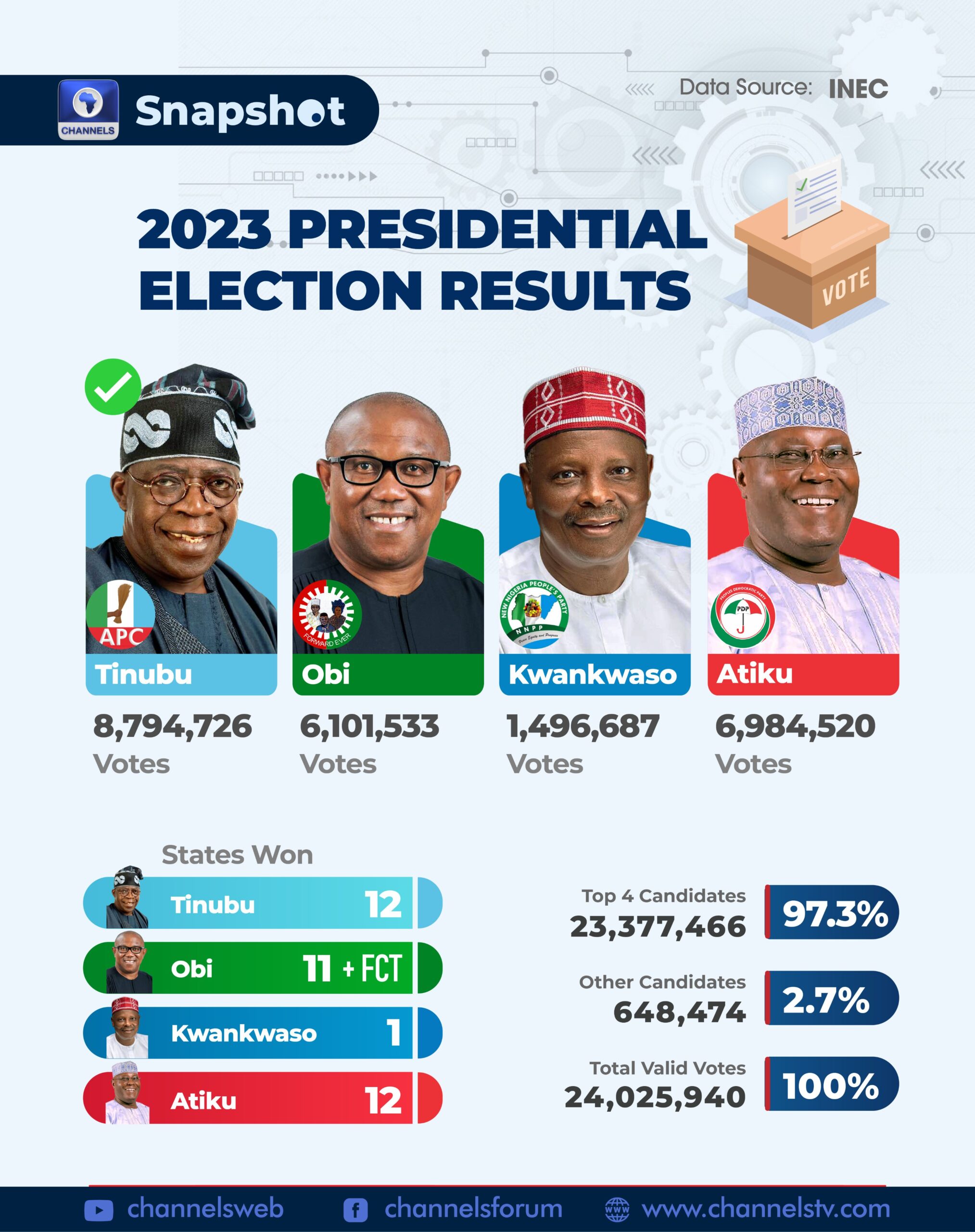
The Independent National Electoral Commission (INEC) has declared Bola Tinubu as the winner of the 2023 presidential election.
INEC chairman Yakubu Mahmood declared Tinubu the winner of the election and president-elect Wednesday morning at the International Conference Centre, Abuja.
A total of 18 presidential candidates contested the election held across the 36 states of the federation and the Federal Capital Territory (FCT), Abuja, on Saturday.
The election was postponed till Sunday in some polling units in different states due to violence, logistical problems, theft of BVAS and other issues.
After collation at state INEC collation centres, the election results were presented by state collation officers for the presidential election (SCOPs) before the INEC chairman at the National Collation Centre.
Mahmood announced that Tinubu, a former Lagos State governor and the candidate of the All Progressives Congress (APC) won the election with the majority of votes cast in 36 states of Nigeria and the FCT.
The APC candidate polled 8,794,726 votes to defeat fellow contenders – Atiku Abubakar of the opposition People’s Democratic Party (PDP) who polled 6,984,520 votes, Labour Party’s Peter Obi had 6,101,533 votes to come third and candidate of the New Nigeria People’s Party (NNPP) Rabiu Kwankwaso with 1,496,687 votes.
Of the 36 states and FCT, Tinubu, Obi, and Atiku won 12 states each while Kwankwaso won only Kano State.
The 12 states won by Tinubu are Ogun, Oyo, Osun, Kwara, Benue, Rivers, Borno, Zamfara, Jigawa, Ondo, Kogi and Niger State.
Atiku of the PDP won Taraba, Osun, Akwa Ibom, Adamawa, Kaduna, Sokoto, Yobe, Bayelsa, Kebbi, Bauchi, Gombe and Katsina.
Obi won the following states; Ebonyi, Enugu, Imo, Anambra, Abia, Delta, Edo, FCT, Plateau, Nasarawa, Lagos and Cross River.

The Minister of Aviation, Hadi Sirika confirmed the Federal Government have lifted the ban on Emirates Airline,10 months after the airline company and the government had issues over Covid-19 travel requirements on Nigerian passengers.

He sad;

“Today, we received communications from Emirates removing some of the conditions for travelling for which we had concerns,” he said.
Having done that, it is necessary to lift the ban on Emirates.
This subsequent lifting of the ban is a product of lengthy negotiations between us and them.”he said