
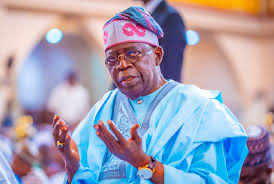
President Bola Tinubu urged state governors on Thursday to cease building flyovers in low-traffic areas and instead direct their greatly increased federal budget toward road networks that would improve living conditions and provide security services with greater access to rural areas.
He observed that states were now receiving four to five times as much from the Federation Account as they were previously.
President Tinubu issued the charge while receiving a delegation of traditional rulers from Oyo State, led by the Olubadan of Ibadanland, Oba Rashidi Ladoja, who visited to congratulate him on the successful rescue of abd*cted schoolchildren and teachers from Oriire Local Government Area after 56 days in captivity.
Addressing Ladoja and other former governors present, Tinubu noted that the cost of running government is high, but argued that the funds now being channelled to states far exceed what was available during previous administrations, whether his own earlier tenure or theirs.
He said states are now receiving four to five times more than before, adding that no state currently needs to borrow money to pay salaries, and that pensioners are being paid as at when due.
He urged state governments to prioritise building roads and artery networks instead of flyovers in areas with little traffic, stressing that better road networks would improve quality of life and give security agencies greater access to penetrate hard-to-reach areas.
Also at the meeting, Tinubu disclosed that the terrorists who abdcted the schoolchildren and teachers in Oriire last May had demanded, alongside a ransom, the release of their jailed members, a demand that was flatly refused.
He revealed that his directive to expand the Army from eight to twelve divisions was a direct operational response to the Oriire abdctions crisis, explaining that the expansion was meant to shorten response times and give security forces the numerical and geographic capacity needed to defeat terr0rism and b@nditry.
Tinubu reiterated that his administration will not negotiate with terr0rists or pay ransoms to secure the release of victims.
Speaking publicly on the matter for the first time since the Oyo abductees were rescued on July 10, he said the criminals had demanded the release of already-arrested members of their gang as one of their conditions, alongside the ransom sought, and that the government refused the deal outright, insisting it would not negotiate with criminals.
He said the perpetrators had committed murd£r and that security forces were prepared to go after their families and communities if necessary, noting that these criminals came from somewhere and were known.
He commended the armed forces for their performance in the rescue operation and said he was accepting the traditional rulers’ commendation on the military’s behalf, promising to relay the message accordingly.
Tinubu explained that the rescue was made possible because the military had detailed knowledge of the forest’s geographical layout, adding that every security incident offers the Federal Government fresh lessons that necessitate structural adaptation.
He said each event forces a re-examination of the country’s security architecture, strategy and operations, noting that the government’s response has combined both geographical and numerical measures.
Refusing ransom payments while leveraging knowledge of the terrain, and expanding the Army from eight to twelve divisions to shorten response times and strengthen the fight against terr0rism and b@nditry.
He added that the government is also addressing long-standing gaps in local-level security, noting that state police will soon be established with safeguards against abuse, and that traditional rulers would be expected to play a greater role going forward.
The President attributed the rise in kidn@pping and terr0rist att@cks partly to the security collapse in Nigeria’s Sahel neighbours, noting that some of those involved are non-Nigerians and that the instability in Mali, Burkina Faso and Niger Republic has worsened the country’s security challenges.
He said this underscores the need to strengthen the capacity of forest guards and to establish state police.