Categories
News

I Still Can’t Tell My Exact Age — Obasanjo Opens Up

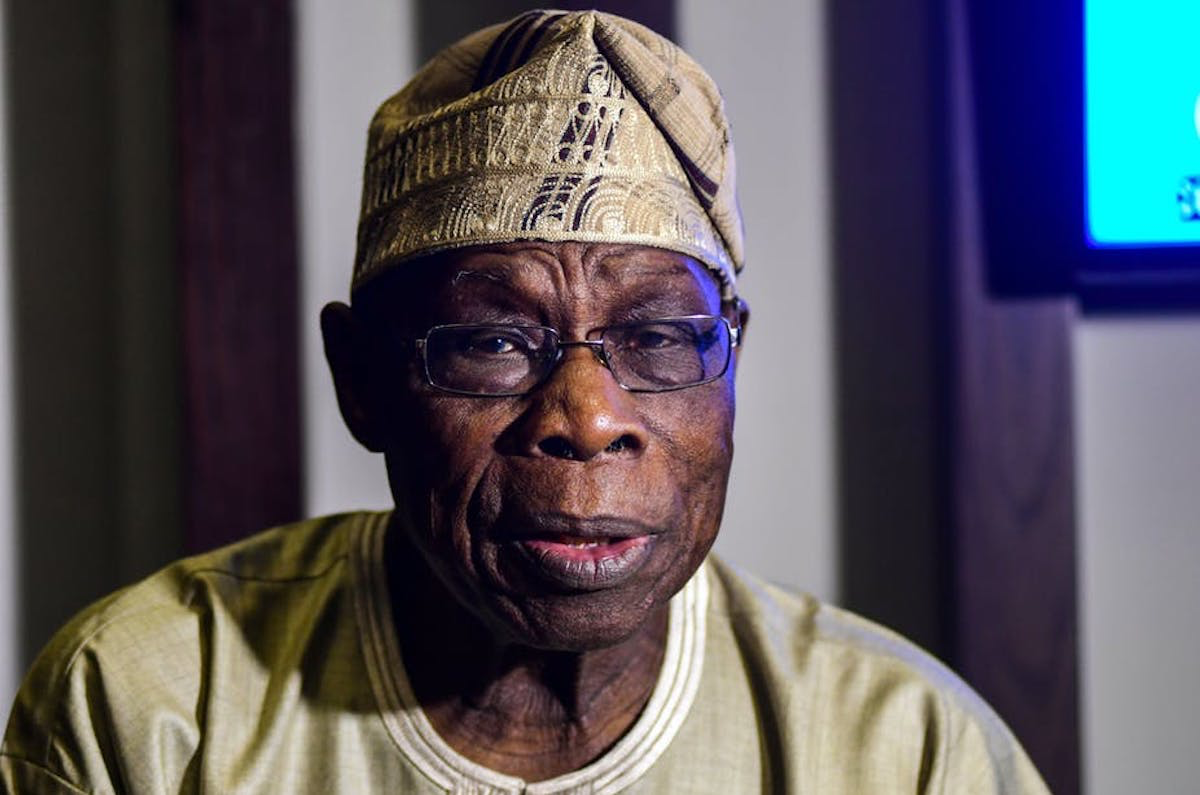
Chief Olusegun Obasanjo, Nigeria’s former President, has once again admitted that he does not know his exact age, saying he can only make guesses based on how old his classmates were.

He explained that several of his contemporaries from primary school are still alive, and none of them is younger than 90 years.

Obasanjo made this disclosure on Sunday while speaking at the Toyin Falola Interview Series titled “A Conversation with His Excellency, Chief Olusegun Obasanjo.”

The session was moderated by Professor Toyin Falola, with the participation of the Bishop of Sokoto Diocese, Dr. Matthew Kukah, and former presidential candidate, Professor Kingsley Moghalu.

During the interview, the former president also spoke about the purpose behind establishing his presidential library, describing it as a tool for safeguarding national records and strengthening institutional memory. According to him, millions of documents have already been digitised.

He said, “We have digitalised over 3m materials. We still have about the same number, 3m to digitalise.

“The idea is when these materials are digitalised, people can have access to them. That is number one. As document preservation, we preserve the past, take note of the present and we want all these to inspire the future.”

Obasanjo further disclosed that several personal and historical records are preserved in the library, including his academic files and private correspondence.

He explained that the facility houses his primary and secondary school records, a letter he wrote to former military ruler, General Sani Abacha, after the death of his son, and another letter addressed to his wife during his imprisonment.

Despite the availability of these records, Obasanjo maintained that he still could not definitively state his age, but pointed to surviving classmates as possible references.

He said, “I don’t know my exact age but I could judge from those who were in school with me, I have given you an example of Olubara (Oba Jacob Olufemi Omolade, the Olubara of Ibara) who is still alive.

“I believe there are six of my classmates in secondary school that I know are still alive and none of them is less than 90 years of age. So I leave it to you to guess what my age could be.

“My school record card in primary school, I have been able to keep them and when I became President and I wanted to establish the library, they were available to be exhibited.

“My records in primary and secondary school and even the manuscripts of books that I have written, those that I wrote in prison and so on, even crops of maize that I planted when I was in prison, they are there and somehow I was able to keep them.

“Why the Presidential Library? I believe one of the things we don’t do too well in our society is that we don’t keep records too well, institutional memory is not what we do very well.”

Categories
News

Boko Haram Began Under Your Watch, Presidency Fires Back At Obasanjo

Sunday Dare, Special Adviser on Media and Public Communication to President Bola Tinubu, has condemned former President Olusegun Obasanjo and other critics, accusing them of making “ignoble” attempts to undermine the administration’s ongoing efforts to tackle terrorism in Nigeria.

In a statement titled “Between Tinubu’s Capability and the Ignobility of Pseudo Statesmanship,” issued via his X handle on Sunday, Dare addressed recent comments from Obasanjo and “habitual presidential aspirants” portraying the Tinubu government as incapable of protecting Nigerians.

Dare argued that such criticisms ignore the reality of widespread terrorist threats and amount to “capitulation” rather than genuine statesmanship.

Obasanjo and other opposition leaders, including ex-Vice President Atiku Abubakar and former presidential candidates, had in recent weeks criticised the rising attacks in the country and faulted the Federal Government’s non-kinetic approach.

Speaking at a Jos, Plateau State event on Friday, Obasanjo expressed displeasure over rising insecurity, saying Nigerians have the right to seek foreign intervention to cover what he described as the government’s failure to protect its citizens.

“No matter what religion you belong to. No matter where you come from. No matter your profession, we Nigerians are being killed, and our government seems to be incapable of protecting us.

“We are part of the world community. If our government cannot do it, we have the right to call on the international community to do for us what our government cannot do for us,” he said.

Reacting, Dare described the ex-president’s comments as “hypocritical and ignoble,” stating they ignored historical realities and insisting that Boko Haram incubated and grew under Obasanjo’s civilian administration.

“The suggestion that Nigeria should effectively subcontract its internal security to foreign governments is not statesmanship; it is capitulation.

“Before recommending surrender, the former President should reflect on what he failed to do when these terrorists first began organising under his watch,” the statement reads in part.

“It is historical fact that the ideological foundations and early cells of Boko Haram were incubated during Obasanjo’s civilian presidency. While they recruited, indoctrinated, built camps, and flaunted authority, the state failed to act decisively. 

“What began as a preventable extremist sect transformed into a violent insurgency, a cross-border terrorist franchise, a regional menace aligned with global jihadist movements.


“For the leader under whom the first seeds of terrorism were allowed to germinate to now issue public lectures is not just ironic, it is reckless,”
Dare added.

The presidential aide stressed that Tinubu is confronting a multifaceted terrorist threat through a combination of military pressure, intelligence-led operations, governance restoration in contested areas, and community and counter-radicalisation programmes.

Dare added that undermining the government’s capacity could embolden terrorists.

“When former leaders disparage the nation’s capacity, they hand psychological victories to the very terrorists murdering, kidnapping, and extorting Nigerians.

“If Obasanjo wishes to help, he should acknowledge the past failures that allowed terrorists to gain a foothold, and then support ongoing efforts, not undermine them.

“Let him put his position and connections at Nigeria’s disposal like he has done for other countries. Not seek to put down an administration that is fully engaging on many fronts: economic turnaround, providing security, and building key infrastructure,” he added.

The aide called on all Nigerians to support the administration’s security strategies.

“President Bola Ahmed Tinubu remains committed to securing every inch of Nigeria by confronting terrorists with strength, unity, and a whole-of-government strategy. Let all patriots join hands now and not raise alarms.

“This administration will not be distracted by selective amnesia wrapped in elder-statesmanship, nor will it allow those who midwifed Nigeria’s early security failures to rewrite history,” Dare said.

Categories
News

A Pig Will Forever Remain A Pig – Fayose’s Brother Blasts Him For Insulting Obasanjo

Isaac Fayose, the younger brother of former Ekiti State Governor Ayo Fayose, has criticized him for his verbal assault on former President Olusegun Obasanjo.

626Blaze had earlier reported that the former governor had sent a blistering message to the former president, accusing him of being “irresponsible” and claiming he “belongs in the zoo.”

The message, which was made public by Obasanjo’s media aide, Kehinde Akinyemi, accused the former president of losing his sanity and suffering from “heightened dementia.”

In the SMS, Fayose wrote: “Someone once said you are supposed to be kept away in the zoo. Sincerely that’s where you belong.”

He also demanded the return of money he claimed Obasanjo had acknowledged receiving, adding that he chose not to reply at the birthday venue so the public could “see the difference between a sane and a mad man.”

Obasanjo, in a brief and sharp response, thanked Fayose for the message, saying it revealed “who and what you are, unchanged and unchangeable.”

Reacting to the spat between the duo, Isaac openly condemned his brother, describing him as “a pig who will forever remain a pig.”

Speaking via his Instagram account, he wrote, “A pig will forever remain a pig irrespective of the garlands you dress him in.”

He accompanied the post with the press statement in which his elder brother harshly criticised Obasanjo.

Categories
News

Why I Rejected The Idea To Make El-Rufai My Successor – Obasanjo

Olusegun Obasanjo, a former President of Nigeria, has disclosed that he once turned down a suggestion to back former Kaduna State Governor, Nasir El-Rufai, as his successor when his presidency ended in 2007.

Obasanjo, on Friday, said he rejected the idea because he believed El-Rufai was not yet mature enough to handle the responsibilities of leading the country.

El-Rufai, who served under Obasanjo’s administration first as Director-General of the Bureau of Public Enterprises and later as Minister of the Federal Capital Territory, was among the prominent figures in his cabinet between 1999 and 2007.

Speaking during the second edition of the Ajibosin Platform Annual Symposium in Abeokuta, Ogun State, Obasanjo disclosed that former Minister of Aviation, Osita Chidoka, recommended El-Rufai as his potential successor.

Chidoka, who was the keynote speaker at the event, earlier recounted how El-Rufai introduced him to Obasanjo at the age of 34 — an encounter that eventually led to his appointment as Corps Marshal of the Federal Road Safety Corps.

Interrupting Chidoka’s presentation, Obasanjo reminded the audience of a detail he had left out.

“Let him tell you. He didn’t mention that. He was pushing when I was leaving government that his friend, El-Rufai, should be brought in as my successor,” Obasanjo said, turning to Chidoka.

Facing him directly, the former president asked jokingly, “No be so (Is that not true)?” to which Chidoka nodded in agreement.

Obasanjo said he turned down the suggestion because El-Rufai needed more time to grow politically and personally.

“I did not yield to the pressure. Later, he said, ‘I suggested this person, why didn’t you agree?’ I said El-Rufai needs to mature. You remember? 

“When I left government and, many years later, he saw the performances of El-Rufai, he came back to me and said, ‘You’re absolutely correct. El-Rufai needed to mature,’”Obasanjo recalled.

He went on to commend Chidoka, El-Rufai, and other members of his former team, describing them as individuals with “special attributes” that contributed to his administration’s achievements.

Speaking on leadership, Obasanjo stressed that character, exposure, experience, and training are essential qualities for those in public service.

“It’s only in politics that I found out there is no training for leadership. Even among armed robbers, I was told there is an apprenticeship. But it’s only in politics that there is no training in leadership. That’s not good enough,”
he said.

Delivering his keynote address, Chidoka said Nigeria’s persistent problems were not due to a lack of ideas but to a failure to build enduring systems and institutions.

“Leadership finds its true measure not in speeches or charisma but in the systems it leaves behind.

“Moral conviction must translate into the everyday machinery of governance—rules, routines, and institutions that make competence predictable and corruption difficult.

“Nigeria’s problem has never been a shortage of ideas; it is the absence of systems strong enough to outlive their authors,” Chidoka said.

He called for accountability mechanisms that measure leadership by results rather than rhetoric.

“We must therefore make leadership accountable not to rhetoric but to results: measure by building national dashboards and accountability systems that track every promise, every budget, every outcome. Monitor by strengthening the institutions that evaluate government performance and expose complacency,”
he added.

Categories
News

I Took Him to Tanzania, Senegal – Obasanjo Reveals How He Helped Dangote Succeed

Former President Olusegun Obasanjo has revealed how he helped Africa’s richest man, Aliko Dangote make it in business.
Obasanjo spoke on Wednesday.
According to him, he created an enabling environment to ensure that Dangote built his cement factory in Nigeria, he took him to Tanzania, Senegal, and other African countries.
Speaking at the Bauchi State economic and investment summit, Obasanjo stressed the need for public, private sector partnership.
He said: “So Aliko then planned to produce 5 million tons of cement a year. Since we started producing cement in 1956 up to 2003, we’ve never produced 5 million tons.
 
“So when Aliko made that projection, the people in the ministry said he was telling a lie. He wants to be making it up. I said alright, let’s see how his lie will work.
 
“So I put two people on Aliko’s construction site and they are reporting to me every day. The day Aliko the contractor did not work, they will phone and tell me. And I will immediately phone Aliko.
 
“So one day Aliko came to me and said, Mr. President, I’m getting worried about you. I said what have I done? He said you know about this cement project more than myself. And it is not a government project. I’m getting worried about you. I said my brother Aliko, this is a Nigerian project. So anything Nigerian is a government project.
 
“Not only did Aliko succeed in the first 5 million, he succeeded in the second 5 million. He succeeded in the third 5 million. I started taking him out to other countries in Africa.
 
“I took him to Tanzania. I took him to Senegal. That’s how Aliko made it. Partnership between the private and the public. Partnership between leadership at every level.”
Categories
News

Boko Haram Has Become Part Of Nigerians’ Life – Obasanjo

Former President Olusegun Obasanjo has stated that the Boko Haram insurgency has become a daily reality for Nigerians.

Obasanjo stated this on Friday in Abuja at the public presentation of ‘Scars: Nigeria’s Journey and the Boko Haram Conundrum’, a book authored by former Chief of Defence Staff, Gen. Lucky Irabor (retd).

He urged Nigerians to confront the menace with deeper questioning and stronger resolve.

“Boko Haram is now virtually becoming part of our life. Should we accept that? If we should not accept it, what should we do?

“How much do we know? Even from the other side, and from this side, have we been active enough? Have we been proactive enough?

“I think we have to ask ourselves the necessary questions to be able to deal with this thing that is now becoming a monster within our country,” he said.

Present at the event were former President Goodluck Jonathan, service chiefs, former and serving governors, and clerics, among others.

Categories
News

Obasanjo Is The Most Successful President Since 1999, But He’s Also A Bully – Osinbajo’s Ex-Spokesman

Laolu Akande, former spokesperson for ex-Vice President Yemi Osinbajo, has hailed Olusegun Obasanjo as one of Nigeria’s best-performing presidents since 1999.

Akande, however, noted that Obasanjo capitalized on bullying to push his third-term agenda.

He explained that the former president bullied those in power as a strategy to advance his third-term ambitions because they could not fight back.

Akande made the remarks on Channels Television’s programme, Inside Sources.

He said: “Ex-President Obasanjo is about the best-performing president since 1999. We cannot deny that. And it’s not easy even for me to say that because I saw another administration. But we cannot deny the fact that so far, President Obasanjo’s administration is the one that has the highest level of success.

“So we must understand the strategy of President Obasanjo. He knows that he has the bully pulpit, and he uses it to raise a loud voice, knowing that the people who would counter him don’t have an equally loud voice.”

This comes as the former president denied widespread reports that he sought a third term.

It had been reported that Obasanjo allegedly bribed the then National Assembly in a bid to amend the constitution to secure a third term, but he was reportedly resisted by lawmakers.

Categories
News

Vote Out Any Leader Who Fails To Perform – Goodluck Jonathan

Former President Goodluck Jonathan has stated that leaders who fail to deliver on their responsibilities should be removed from office through credible and transparent elections.

This is as former President Olusegun Obasanjo and the President of Ghana, John Dramani Mahama, called for the reform of democracy and its protection in Africa.

Jonathan stated that electoral manipulation is one of the biggest threats to democracy in Africa.

According to him, unless stakeholders come together to rethink and reform democracy, it may collapse in Africa.

Jonathan stated this at the 2025 edition of the Goodluck Jonathan Foundation, GJF, Democracy Dialogue, held in Accra, Ghana.

The former Nigerian leader, in a statement issued on Saturday by Communications Officer at Goodluck Jonathan Foundation, Wealth Dickson Ominabo, said where democracy fails to meet expectations, desperation can open the door to authoritarianism.

He added that leaders must commit to the kind of democracy that guarantees a great future for the children, where their voices matter.

“Democracy in the African continent is going through a period of strain and risk of collapse unless stakeholders come together to rethink and reform it. Electoral manipulation remains one of the biggest threats in Africa.

“We in Africa must begin to look at our democracy and rethink it in a way that works well for us and our people. One of the problems is our electoral system. People manipulate the process to remain in power by all means.

“If we had proper elections, a leader who fails to perform would be voted out. But in our case, people use the system to perpetuate themselves even when the people don’t want them,” he said.

Also speaking, the President of Ghana, Mahama, said democracy would not survive unless Africans actively worked to protect and strengthen it.

He warned that weak institutions, elite capture, exclusion, leadership deficits, and external interference erode citizens’ trust in democracy.

On his part, former President Obasanjo, who was the chairman of the event, warned that democracy risks collapse if it continued to be practised in its current form without urgent reforms.

He said Africa’s current democratic practice is unsustainable and must be urgently reformed.

Categories
News

Why Nigeria’s Judiciary Is Deeply Compromised – Obasanjo Speaks

On Friday, former Nigerian President, Olusegun Obasanjo voiced concern that Nigeria’s judiciary is now “deeply compromised.”

Obasanjo noted that corruption among judges has turned Nigerian courts into “court of corruption rather than courts of justice”.

The ex-President made the assertion in his new book, ‘Nigeria: Past and Future’, published by the Olusegun Obasanjo Presidential Library.

The former Nigerian leader lamented what he described as the “steady decline of the judiciary’s integrity”.

“The reputation of the Nigerian judiciary has steadily gone down from the four eras up till today. The rapidity of the precipitous fall, particularly in the Fourth Republic, is lamentable,”
he wrote.

The former military Head of State equally stated that justice had become commodified in Nigeria, with dangerous consequences for the nation’s stability.

“The great fear of most well-meaning Nigerians and good friends of Nigeria is that where ‘justice’ is only available to the highest bidder, despair, anarchy, and violence would substitute justice, order, and hope.

“I went to a state in the North about ten years after I left public office. Next to the government guest house was a line of six duplex buildings.

“The governor pointed to the buildings and stated that they belonged to a judge who put them up from the money he made from being the chairman of election tribunals,” Obasanjo said.

He accused the Chairman of the Independent National Electoral Commission, INEC, Mahmood Yakubu, of undermining the electoral process since 2015.

“No wonder politicians do not put much confidence in an election which the INEC of Professor Mahmood Yakubu polluted and grossly undermined to make a charade,”
he added.

Categories
News

‘You’re A Stupid Boy’ — Otedola Recounts His Encounter With Obasanjo In New Book

Billionaire businessman, Femi Otedola has shared details of a heated encounter with former President Olusegun Obasanjo over diesel deregulation, in his forthcoming memoir titled Making It Big: Lessons from a Life in Business.

In excerpts from the book, Otedola recalled that Obasanjo lashed out at him in 2004 following reports of diesel scarcity across Nigeria.

At the time, the federal government had recently deregulated diesel importation based on advice from Otedola and other private sector players.

Otedola’s company, Zenon Petroleum, had assured the presidency that private firms could meet national demand without the involvement of the Nigerian National Petroleum Corporation (NNPC), which was then the sole importer, operating under a subsidy regime.

“When President Obasanjo deregulated diesel in 2004, Zenon took an unassailable lead in the market,” Otedola wrote.
“My opponents’ reaction was to tell the president that we’d turned the market upside down… and that industries were shutting down because there was no diesel.”

According to him, Obasanjo called him around 2am, visibly furious. “‘You’re a stupid boy! God will punish you!’ he shouted. ‘You persuaded me to deregulate diesel, and now there’s no diesel in the country!’”

Otedola said he flew to Abuja the next day to clarify the situation. “As soon as Obasanjo saw me, he flew into a rage again… I allowed him to cool down, and when he stopped talking, I explained the situation,” he wrote.

He told the former president that there were six ships with diesel waiting to discharge, and provided letters of credit as evidence.

He also alleged that some officials within the NNPC, opposed to deregulation, had deliberately misled the president to protect their subsidy benefits.

To counter the misinformation, Otedola said he began publishing the availability and price of diesel in newspapers to reassure the public and government of steady supply.

He described Obasanjo as a “determined and robust president” who, once convinced of a person’s integrity, stood firm in his support.