Categories
News

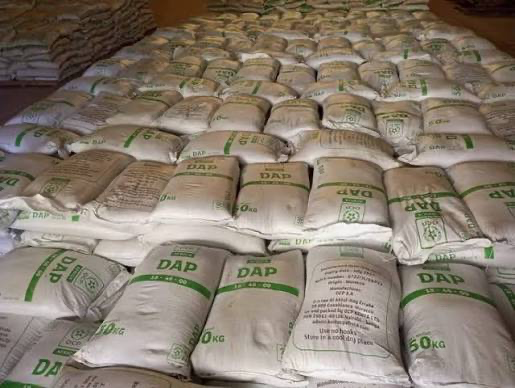
FG Orders 3 Million Bags of Fertiliser for Farmers

The Federal Government has ordered the immediate production and release of more than three million bags of fertiliser for farmers ahead of the dry season farming period.

Vice President Kashim Shettima announced the directive on Monday at the Presidential Villa in Abuja.

He was speaking at a meeting with fertiliser industry stakeholders and asked the relevant agencies and operators to speed up implementation.

The move follows President Bola Tinubu’s approval of funding under the Renewed Hope Agricultural Stabilisation and Productivity Initiative.

The aim is to lower fertiliser prices, raise food output and revive Nigeria’s fertiliser blending industry.

Shettima asked the Office of the National Security Adviser to check and track fertiliser stocks declared by operators, to keep distribution transparent.

He also asked the NSA’s office to make sure farmers in insecure and hard to reach areas are not left out.

Kashim also said reviving the industry would boost farm output, create jobs and support economic activity.

He noted that many blending plants are working below capacity even as demand rises and fertiliser prices keep climbing, pushing up farmers’ costs.

Categories
News

FG Warns Nigerians Against Using Dangerous Chemicals in Food

The Federal Government is warning food sellers and makers to stop using harmful chemical to prepare food.

Among the practices it named are calcium carbide to ripen fruit, paracetamol to soften meat, and detergents in cassava processing.

Minister of Innovation, Science and Technology Dr Kingsley Udeh raised the concern on Tuesday at the 2026 World Science Day for Peace and Development in Abuja.

Udeh also pointed to the use of unapproved chemicals to preserve beans and grains, and the illegal dye Sudan IV, which is sometimes added to palm oil.

He said such practices put public health at risk and erode trust in food products.

Citing WHO figures, he said foodborne illnesses affect about 866 million people globally each year and cause roughly 1.52 million deaths.

He said Nigeria records an estimated 50 million cases of food related illness and more than 53,000 deaths a year.

To tackle the problem, the government plans to deploy qualified food scientists and technologists, especially at the local government level.

Udeh said Nigeria produces about 3,000 food science graduates each year from 70 tertiary institutions, but there is no formal professional structure to put them to work in public service.

He said a professional cadre will be set up for them.

He also urged food businesses and regulators to hire registered professionals with valid practice licences.

Categories
News

FG Plans New Rules for Scrap Metal Dealers to Stop Cable and Metal Theft

The Nigerian government is making new rules for people who buy and sell scrap metal.

It is done to stop thieves from stealing public properties like bridges, electrical cables and rail tracks selling them as scrap.

Government is introducing a new draft called the Scrap Metal Regulations 2026 to clean up and track the scrap metal industry.

Minister of Steel Development Shuaibu Audu announced this in a statement on Tuesday.

He said the theft of electricity cables, railway parts and manhole covers is causing losses, service disruptions and higher repair costs.

The minister was represented by Ime Eprikpo at a two day stakeholders’ meeting in Lagos to review the draft.

Audu said the aim is not to shut down honest businesses.

The rules would also bring small scrap collectors into the formal system, while putting tighter controls on big processing plants.

He added that scrap is an important raw material for steel makers and could create jobs if handled properly.

The Permanent Secretary, Nura Abba Rimi, said the rules would help protect public and private property and give legitimate businesses and investors more confidence.

The National Association of Scrap and Waste Dealers Employers of Nigeria called the review a landmark step.

The ministry says it will consider feedback from stakeholders before the rules are finalised.

Categories
News

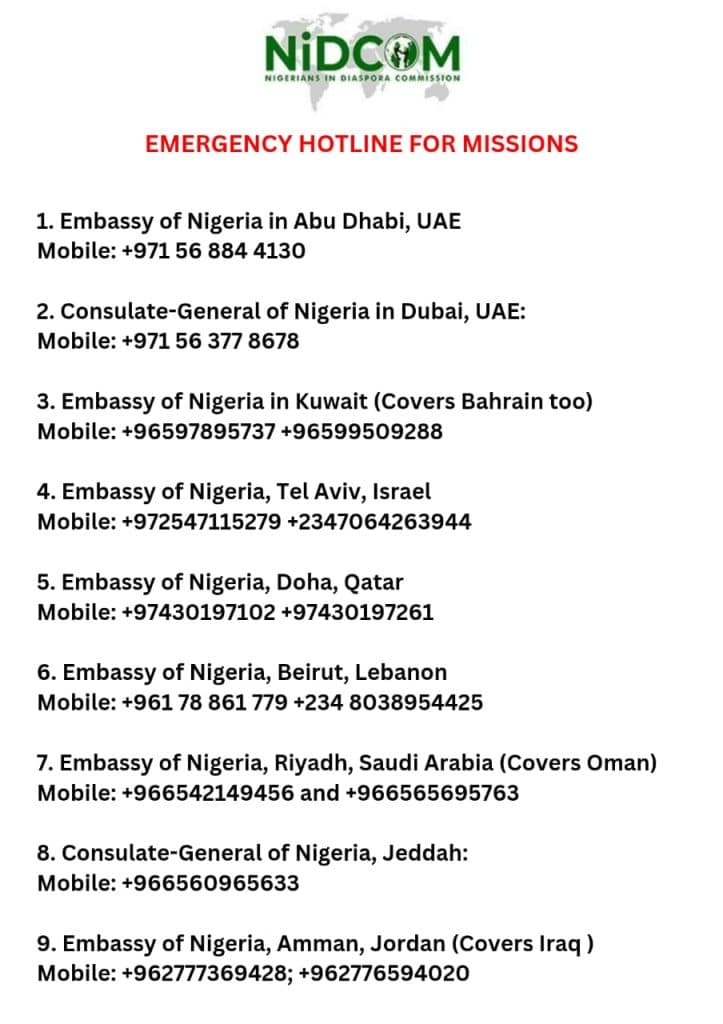
Iran War: FG Releases Emergency Contacts For Nigerians In Middle East (Full List)

The Federal Government has issued emergency contact details for Nigerian diplomatic missions across the Middle East to support citizens impacted by the escalating conflict in the region.

The advisory was issued in Abuja by the Federal Ministry of Foreign Affairs Nigeria and signed by its spokesperson, Kimiebi Imomotimi Ebienfa.

According to the ministry, the emergency contacts were provided to enable Nigerians living in or travelling across the Middle East to quickly reach diplomatic missions for assistance as tensions escalate in the conflict involving Iran, Israel, and the United States.

The ministry explained that the emergency contact list covers Nigerian diplomatic missions in 10 countries across the Middle East affected by the ongoing hostilities.

It urged Nigerians in the region to maintain communication with the nearest Nigerian embassy or consulate.

“Further to established communication channels publicised by the various Nigerian missions in the Middle East region, Nigerian citizens affected by the ongoing crisis should contact the following mobile numbers in case of emergency and also ensure that they are registered with the respective embassy or consulate in their country of residence,” the statement said.

The ministry listed the following emergency numbers for Nigerian diplomatic missions in the region:

  • Embassy of Nigeria, Tehran (Iran): +98 937 685 1897; +98 933 951 5348; +98 930 972 9965; +234 906 768 4063
  • Embassy of Nigeria, Tel Aviv (Israel): +972 547 115279; +234 706 4263944
  • Embassy of Nigeria, Abu Dhabi (UAE): +971 56 884 4130
  • Consulate-General, Dubai (UAE): +971 56 377 8678
  • Embassy of Nigeria, Kuwait (covers Bahrain): +965 9789 5737; +965 9950 9288
  • Embassy of Nigeria, Doha (Qatar): +974 3019 7102; +974 3019 7261
  • Embassy of Nigeria, Beirut (Lebanon): +961 78 861 779; +234 803 8954425
  • Embassy of Nigeria, Riyadh (Saudi Arabia): +966 542149456; +966 565695763
  • Consulate-General, Jeddah (Saudi Arabia): +966 56 096 5633
  • Embassy of Nigeria, Amman (Jordan – covers Iraq): +962 777 369428; +962 776 594020

Authorities advised Nigerians to register with their respective embassies to facilitate communication and emergency support.

The government had earlier issued a security advisory to Nigerians living in or travelling across Iran and other Gulf countries following the escalation of the regional conflict.

According to the ministry, diplomatic missions in Qatar, Bahrain, Kuwait, the United Arab Emirates and Saudi Arabia have been placed on high alert to provide consular assistance where necessary.

Categories
News

Nigerian Govt To Share Electricity Subsidy Burden With States, LGs

The Federal Government has announced plans to end its sole responsibility for electricity subsidies, unveiling a new framework that will see the costs shared among the federal, state, and local governments starting in 2026.

The Director-General of the Budget Office of the Federation, Tanimu Yakubu, disclosed this on Monday in Abuja during a training and sensitisation workshop for ministries, departments and agencies, MDAs, on the 2026 post-budget preparation process, conducted using the Government Integrated Financial Management Information System, GIFMIS, Budget Preparation Sub-System.

Yakubu said President Bola Tinubu had directed that electricity subsidies be clearly identified, properly monitored and equitably distributed across all tiers of government, warning that the existing arrangement had created hidden liabilities and repeated crises within the power sector.

“If we want a stable power sector, we must pay for the choices we make. When tariffs are held below cost, a gap is created. That gap is a subsidy. And a subsidy is a bill,” Yakubu said.

He explained that from 2026, electricity subsidies would no longer be treated as an unlimited federal responsibility, particularly where policy decisions and political benefits are jointly shared by multiple levels of government.

“In 2026, we will stop pretending that this bill can be left to the Federal Government alone, especially where the policy choice or the political benefit is shared across tiers of government,” he said.

According to the Budget Office chief, the President has instructed that existing laws governing the electricity sector be fully applied to ensure that subsidy-sharing arrangements are transparent, practical and enforceable.

“This means subsidy costs must be explicit, tracked and funded, so they do not resurface as arrears, liquidity shortfalls or hidden market liabilities.

“If any tier of government chooses affordability interventions, the funding responsibilities must be clear, agreed and enforceable,” Yakubu said.

He stressed that the policy was not punitive but designed to align incentives across government and promote efficiency within the power market.

“This is not punishment. It is alignment,” he said, adding: “When everyone carries a fair share of the cost, everyone also has an incentive to support cost-reflective efficiency, targeted protection for the vulnerable, and a power market that can actually deliver.”

Yakubu urged MDAs to clearly reflect subsidy-related obligations in their 2026 budget submissions and avoid transferring unfunded liabilities into the electricity value chain.

Beyond electricity subsidies, he said the 2026 Budget would mark a decisive shift away from rollover budgeting and fragmented project listings, which he noted had weakened implementation and accountability over the years.

“The 2026 Budget corrects this. It is built as one coherent implementation framework,” he said. “The approach is to consolidate commitments into a single, visible pipeline and manage them as a disciplined programme of delivery.”

Describing the model as a “single-train” framework, Yakubu said it would enhance prioritisation, strengthen control mechanisms and eliminate duplication across government.

“One plan. One pipeline. One execution logic,”he said. “It allows the government to know, at any point, what we have committed to deliver.”

He also disclosed that President Tinubu had ordered a review of the Fiscal Responsibility framework to make fiscal rules more dynamic and enforceable rather than discarding them entirely.

“Fiscal rules are the guardrails of the government,” Yakubu said. “Without guardrails, spending becomes impulsive, debt becomes casual, and the budget becomes a statement of intent rather than a tool of delivery.”

According to him, the review will introduce clearer fiscal anchors, better-defined escape clauses for genuine shocks, and a credible return-to-compliance pathway, alongside stronger reporting on contingent liabilities.

For MDAs, he said the changes would significantly alter how proposals are evaluated.

“You will not only be asked what you want to spend. You will be asked how it fits the fiscal rules, how it affects sustainability, and what measurable results it will deliver,” he said.

Yakubu also revealed that the 2026 Budget would deepen the transition from long project lists to structured project financing, insisting that capital proposals must be both delivery-ready and, where applicable, finance-ready.

“A long list of projects is not a development strategy,” he said. “What citizens feel is delivery, completed roads, reliable power, functional schools and working hospitals.”

He explained that projects submitted for funding must demonstrate readiness, clear sequencing, defined financing strategies, measurable outputs and realistic timelines, noting that fewer but well-funded projects would yield greater impact.

Yakubu described the GIFMIS Budget Preparation Sub-System as central to restoring credibility to the budgeting process, calling it “the operating system for credible budgeting” that enhances transparency and traceability from submission to execution.

“The success of the Renewed Hope Agenda is shared,” he said. “The Budget Office will coordinate and enforce standards, but delivery depends on every MDA. Nigerians expect results, and through a credible 2026 Budget, we must deliver.”

Categories
News

Mathematics No Longer Compulsory For Arts Students – FG

The Federal Government has announced that Nigerian senior secondary school students in arts and humanities will no longer be required to present a credit in mathematics as a condition for admission to universities and polytechnics.
FG made the announcement through the Federal Ministry of Education said on Tuesday.
For years, admission seekers in arts and humanities, like their contemporaries in sciences and social sciences, have been mandated to have five credits, including mathematics and English language, to secure admission into higher institutions.
“The revised National Guidelines for Entry Requirements into Nigerian Tertiary Institutions are designed to remove barriers while maintaining academic standards.
 
“The new framework applies to universities, polytechnics, colleges of education, and Innovation Enterprise Academies across the country as follows:
 
“Universities: Minimum of five (5) credit passes in relevant subjects, including English Language, obtained in not more than two sittings. Mathematics is mandatory for Science, Technology, and Social Science courses.
 
“Polytechnics (ND Level): Minimum of four (4) credit passes in relevant subjects, including English Language for non-science courses and Mathematics for science-related programs.
 
“Polytechnics (HND Level): Minimum of five (5) credit passes in relevant subjects, including English Language and Mathematics.
 
“Colleges of Education (NCE Level): Minimum of four (4) credit passes in relevant subjects, with English Language mandatory for Arts and Social Science courses, and Mathematics required for Science, Vocational, and Technical programs,” a statement by the FME’s spokesperson, Folasade Boriowo, said.
An education analyst, Ayodamola Oluwatoyin, who spoke to our correspondent in Abuja, hailed the reform.
“This is a brilliant reform which we hope will open the doors and improve the ease of admissions into tertiary institutions for more seekers.”
The Minister of Education, Dr Tunji Alausa, described the reform as a deliberate effort to expand access to tertiary education.
Categories
News

Strike: ASUU Reacts to FG’s No-Work-No-Pay Directive

The Academic Staff Union of Universities (ASUU) has reacted to the Federal Government’s recent directive of ‘no work, no pay’ policy.
ASUU urged the Minister of Education, Tunji Alausa, to focus on resolving the ongoing dispute with the union instead of issuing threats.
This comes barely 24 hours after university lecturers embarked on a two-week warning strike to press home their demands.
ASUU President, Chris Piwuna, while speaking as a guest on Channels Television’s Politics Today on Monday, dismissed the Federal Government’s ‘No Work, No Pay’ directive, insisting that the union will not be intimidated by threats.
Piwuna said the union remained united and would not succumb to the government’s attempt to divide the academic community.
According to him, all academic bodies, such as the National Association of Medical and Dental Academics (NAMDA) and the Congress of Nigerian University Academics (CONUA), were standing together in support of the strike action.
He said, “We don’t respond to threats, and nobody can threaten us.
 
“He is threatening us, writing to NAMDA and CONUA, telling them they can get their salaries. He wants to divide us, but we are united in this matter.
 
“CONUA is with us, NAMDA is with us, SSANU is with us, NASU is with us. The polytechnics and colleges of education are also with us.”
 
Piwuna also hinted that the union remained open to dialogue and was ready to engage with the Federal Government.
He added, “He has got something coming. He had better sit down and solve this problem or he will fail in trying to divide us.
 
“Today, I received a call from the Minister of State for Labour. She said she has been directed to intervene and get this matter resolved. ASUU is willing. We are ready and available to discuss this matter once and for all.”
Categories
News

ASUU Strike: FG Directs Vice-Chancellors to Stop Lecturers’ Salary

The Federal Government has ordered salaries of lecturers to be stopped.
This is as FG directed vice-chancellors of all federal universities in Nigeria to commence enforcement of “no work, no pay” policy against members of the Academic Staff Union of Universities, ASUU.
Recall that university teachers are currently on strike over FG’s inability to meet their outstanding demands.
The directive was contained in a circular dated October 13, 2025, and signed by the Minister of Education, Dr. Tunji Alausa.
“In line with the provisions of the Labour Laws of the Federation, the Federal Government reiterates its position on the enforcement of the ‘No Work, No Pay’ policy in respect of any employee who fails to discharge his or her official duties during the period of strike action,” the circular reads
The circular was copied to the Head of the Civil Service of the Federation, Director-General of the Budget Office of the Federation, Permanent Secretary of Education, Pro-Chancellors of all federal universities, the Accountant-General of the Federation, and the Executive Secretary of the NUC.
Categories
News

No Work, No Pay – FG Threatens ASUU Over Nationwide Strike

The Federal Government has insisted that its ‘no work, no pay policy’ will be implemented against striking Academic Staff Union of Universities (ASUU) members.
This is as the union embarked on a warning strike this Monday.
In a joint statement released on Sunday, Minister of Education Maruf Tunji Alausa and Minister of State for Education Suwaiba Sai’d Ahmed said the government remains committed to resolving ASUU’s concerns through continued dialogue.
 
“The Federal Government has demonstrated sincerity, patience, and goodwill in its discussions with the Union,” the statement said.
According to the ministers, several of ASUU’s key demands — including enhanced teaching allowances and better conditions of service — have already been addressed.
They added that other unresolved matters fall under the authority of university governing councils, which have been reconstituted to handle them.
 
“Despite these efforts, ASUU has chosen to embark on strike action, a decision that fails to reflect fairness to students or the public,” the statement read.
Reaffirming President Bola Tinubu’s commitment under the Renewed Hope Agenda to maintaining academic stability, the ministers cautioned that the “no work, no pay” policy remains a valid labour law and would be applied if universities are shut down.
They urged ASUU to reconsider its stance and return to the dialogue table, emphasizing that “the government remains open to engagement at all levels to avoid unnecessary disruption in the education sector.”
Categories
News

FG Predicts Heavy Rain, Flood In 14 States (See Full List)

The federal government has cautioned that several communities across fourteen states are at risk of flooding due to heavy rainfall.

The warning was made known in a statement on Thursday by the National Flood Early Warning Centre (FEWS Centre) of the Federal Ministry of Environment.

The statement warned that the heavy rainfall could trigger flooding in 14 states between September 4 and 8, 2025.

The statement, which was signed by the Director of Erosion, Flood, and Coastal Zone Management Department of the Ministry, Usman Abdullahi Bokani, advised relevant stakeholders to be on alert.

The states and localities expected to experience heavy rainfall that could lead to flooding include: Ebonyi (Afikpo), Cross River (Edor, Ikom, Itigidi, Akpap), Kano (Gwarzo, Karaye), Zamfara (Anka, Gummi, Kaura Namoda, Maradun, Shinkafi, Bukuyum), Taraba (Dampar, Duchi, Garkowa, Gassol, Gembu, Gun Gun Bodel, Kambari, Mayo Ranewo, Mutum Biyu, Bandawa, Ngaruwa), Abia (Eziama, Umuahia) and Yobe (Geidam, Kanama, Potiskum).

Others are Plateau (Langtang, Shendam, Wase), Borno (Ngala), Imo (Okigwe, Otoko), Niger (Sarki Pawa), Sokoto (Sokoto, Wamakko, Isa, Shagari, Makira), Kaduna (Kafanchan), and Akwa Ibom (Oron).

The Ministry also requested feedback from “relevant stakeholders and state government representatives” on major developments.

In other news, the Governors of the North-Eastern states of Nigeria have raised alarm over what they described as imminent humanitarian and economic challenges facing the region, including the threat of flooding and a possible food crisis.

The warning came in a statement issued at the end of the 12th meeting of the North-East Governors’ Forum held on Saturday in Jalingo, Taraba State.

Chairman of the Forum and Governor of Borno State, Babagana Zulum, said credible climate forecasts signalled that the subregion could face heavy flooding in the coming months.