Tag: efcc
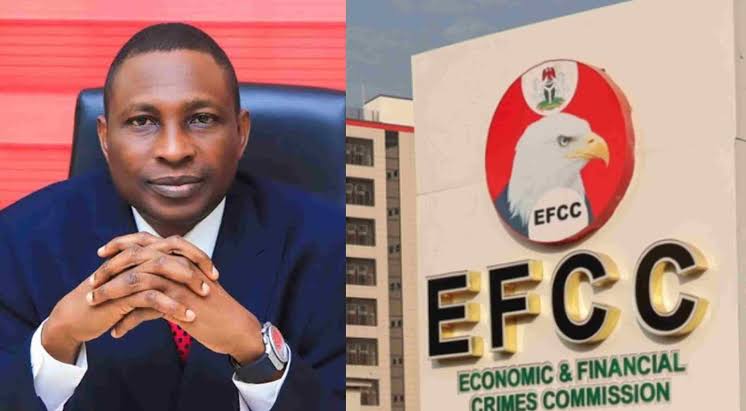
The Economic and Financial Crimes Commission (EFCC) has urged Nigerians who lost funds to the fraudulent online trading platform Crypto Bridge Exchange (CBEX) to visit its Ibadan and Lagos offices to assist with investigations into the alleged multi-million-naira scam.
In a statement issued on Friday by its Head of Media and Publicity, Dele Oyewale, the anti-graft agency disclosed that three suspects — Adefowoara Abiodun Olanipekun, Otorudo Avwerosuo, and Ehirim Justice Chukwuebuka — are already facing prosecution over their alleged roles in the scheme.
The EFCC said CBEX lured unsuspecting Nigerians with promises of mouth-watering returns on cryptocurrency investments but eventually collapsed, leaving many victims stranded and devastated.
According to the Commission, the fraudsters operated through offices in Ibadan, Oyo State, and Idimu, Lagos, where several victims invested funds they could no longer retrieve.
“The scheme led to serious financial losses for Nigerians who invested their funds with the promise of unrealistic returns on investment.
“In view of the foregoing, and the need to assist the Commission in its ongoing investigation, the EFCC is inviting victims who invested their funds through individuals linked to the CBEX offices in Ibadan and Idimu, Lagos, to report to its Ibadan Zonal Directorate and Lagos Zonal Directorate 2,” the statement partly reads.
Operatives of the Economic and Financial Crimes Commission (EFCC) Port Harcourt Zonal Directorate have arrested 36 suspected internet fraudsters in Port Harcourt, Rivers State.
They were arrested on Tuesday, August 19, 2025 in a sting operation at various locations within Port Harcourt following credible intelligence about their suspected involvement in internet- related fraud.
Items recovered from them include different models of exotic vehicles, a Q-link Motorcycle, various brands of phone and laptop containing incriminating and fraudulent documents.
The suspects will be charged to court upon conclusion of investigation.

The Economic and Financial Crimes Commission (EFCC) has uncovered a massive fraud scandal in the turnaround maintenance of Nigeria’s refineries, recovering over ₦5 billion and $10 million from indicted contractors and government officials.
According to insider sources, the anti-graft agency is now pursuing the recovery of an additional ₦10 billion and $13 million believed to have been siphoned through inflated contracts and fraudulent invoicing.
Records show that at least $1.55 billion was allocated to the Port Harcourt refinery, $740 million to Kaduna, and $656 million to Warri—yet none of the plants have returned to optimal function, forcing Nigeria to remain dependent on imported fuel.
“The scale of fraud is staggering,” an EFCC source told our correspondent. “Over-invoicing, inflated contracts, and questionable payments are at the heart of why these refineries have failed. Several former management officials have been arrested and interrogated.”
The agency has reportedly concluded probes into some officials of the Nigerian National Petroleum Company Limited (NNPCL) linked to the fraudulent rehabilitation contracts and is preparing to file charges. Both serving and retired managers may face prosecution.
In addition to the billions already recovered, the EFCC is also investigating fresh allegations of contract inflation worth about $40 million, involving procurement of equipment for the refineries.
When contacted, EFCC spokesperson Dele Oyewale was unreachable, but a senior official confirmed the recoveries and hinted that prosecutions were imminent.
For years, Nigeria’s refineries have been a drain on public finances, with successive administrations pouring billions into turnaround maintenance projects that have yielded little or no results. The EFCC’s probe marks one of the most aggressive efforts yet to unravel the financial rot behind the nation’s fuel crisis.
EFCC Releases Tambuwal From Custody
The African Democratic Congress (ADC) has accused the Economic and Financial Crimes Commission (EFCC) of plotting to go after its Interim National Chairman and former Senate President, David Mark, alleging that he is the agency’s next target.
“The EFCC has now surreptitiously started excavating all the files from David Mark’s tenure as Senate President, 10 years after he left office,”Abdullahi said, describing the timing as suspicious.
He alleged that the investigations are part of a “media trial” strategy aimed at weakening the opposition coalition ahead of the 2027 elections.
The ADC further accused the ruling All Progressives Congress (APC) of shielding its own members from prosecution despite “fresher and better-documented cases” against them, while reviving old allegations against opposition leaders.
“The pattern of ignoring APC stalwarts with fresher and well-documented cases, while targeting opposition figures with stale allegations, is proof of selective justice and an assault on political freedom,” Abdullahi stated. “Having failed to stop the coalition, the jittery ruling party’s next move is to discredit its leaders by getting the EFCC to accuse them of looting the entire treasuries. These are calculated media trials; it matters little whether there is a basis for these accusations—the game is the circus show.”
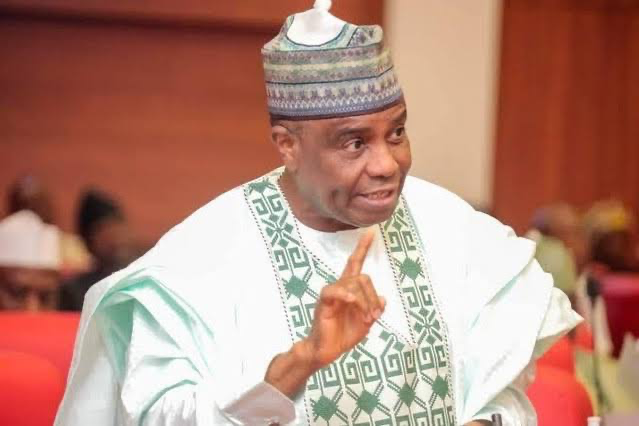
Aminu Tambuwal, former governor of Sokoto State and current senator, is being interrogated by the Economic and Financial Crimes Commission (EFCC)in Abuja over alleged fraud.
This development follows accusations by the African Democratic Congress (ADC) that the EFCC is engaging in selective investigations aimed at opposition figures.
In a statement signed by its National Publicity Secretary, Mallam Bolaji Abdullahi, the ADC alleged that recent EFCC invitations to senior members of the opposition coalition were politically driven and tied to their affiliations.
The party further claimed that some of the cases being revived are not based on fresh evidence but involve reopening old files from previous years.
The Economic and Financial Crimes Commission (EFCC) has revealed that several abandoned estates across the Federal Capital Territory (FCT), Abuja, are owned by civil servants suspected of using stolen public funds to finance the projects.
EFCC Chairman Ola Olukoyede made this known during a policy dialogue in Abuja, organised by Law Corridor.
Olukoyede disclosed that the anti-graft agency has set up a special task force to investigate ownership of such properties nationwide
He said “I have set up a team. We will start visiting all the housing estates, not just in Abuja, but across Nigeria. We want to know who owns what.
“It will shock you that some of these estates have been abandoned for between 10 and 20 years.
“They just take the construction to a certain level and abandon it, and nobody knows what is going on.
“What we have been able to find out is that most of these estates are funded by civil servants, who have stolen money.
“So, the moment they leave public service and the money is no longer coming, they abandon the estates.
“The developer will now begin to look for investors to support them in completing the projects.
“That is one of the things we have discovered in some of these abandoned estates, and we have taken steps to begin to move against some of those estates.
“In recent times, we have had cause to file for the forfeiture of about 15 of them. We have got orders of interim forfeiture.
“What we have discovered is that the issue of money laundering is very rampant among estate developers. It is extremely rampant.
“There is no one who will go to any bank in Nigeria today and borrow money to invest in real estate and make a profit.
“Real estate development takes time; sometimes you are on a project for five years.
“So, if you have gone to a bank to take a loan at over 30 per cent interest, how do you survive?”